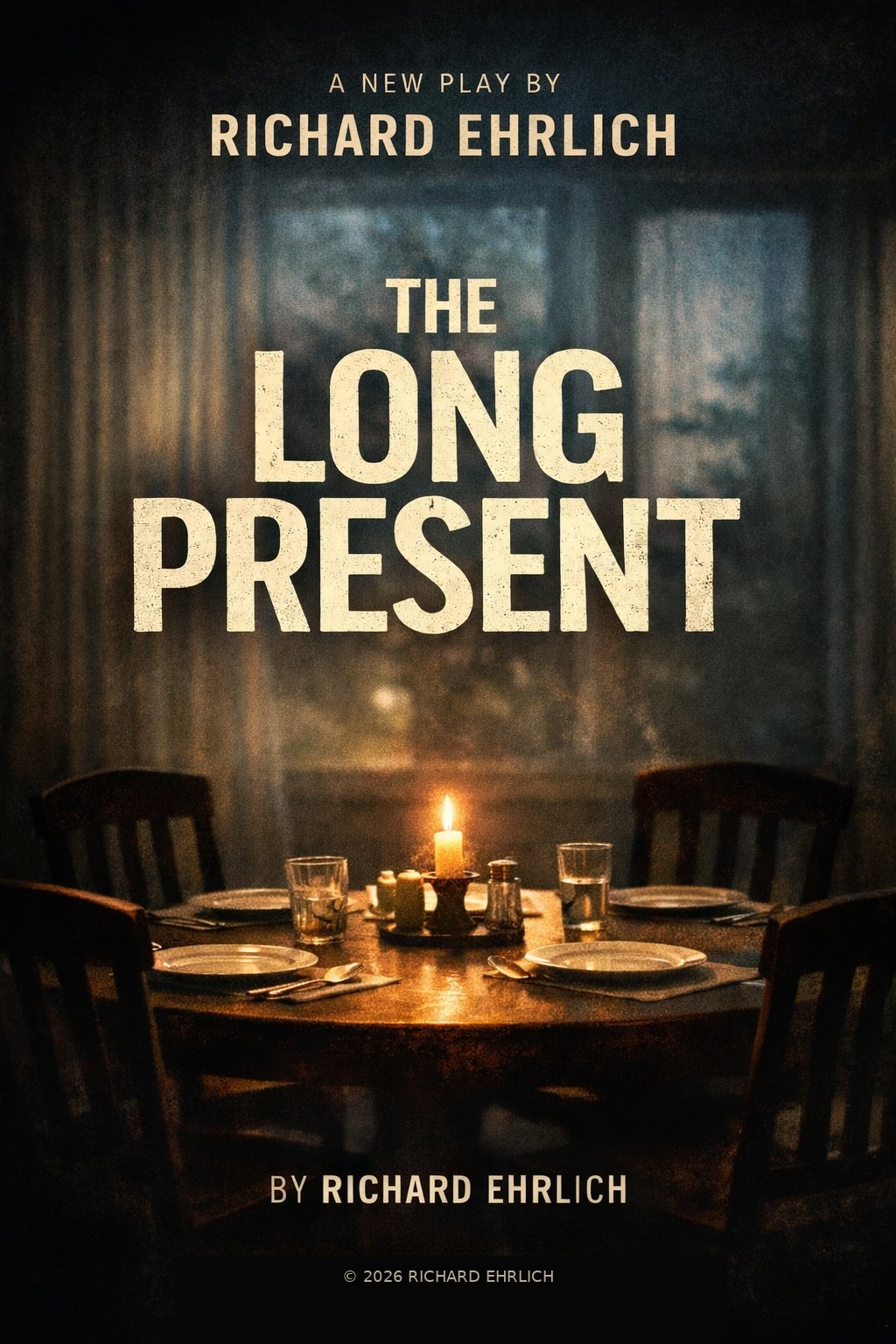
The Long Present
A Play in Five Scenes
The Long Present
A New Play by Richard Ehrlich

TheLong
Present

Why will people endure the loss of everything they love rather than surrender a belief that has become who they are?

~90
Minutes
4
Actors
1
Set
5
Scenes
Explore

A Family Measured in Dinners

Frank and Ellen have been married for decades. He is a retired history teacher who spent a career teaching students what certainty can do to people. She has spent decades translating him to the world — and the work has cost her more than she says.

When their daughter Rachel and her husband Daniel arrive for dinner with a concern about Frank's health, Frank hears it not as love but as an attempt to diminish him. The evening ends in rupture. Rachel leaves the house and refuses to return.

What follows across four more scenes — spread over seven years — is not the story of how a family repairs itself. It is the story of what the damage costs, in different ways, over time. Through letters that almost get written, apologies that almost land, and the slow arithmetic of consequence, the family confronts pride, fear, endurance, and the complicated ways love persists even when people can no longer share the same room.

"All my resistance was really just grief rehearsing itself as principle."


The Central Question

Why will people sometimes endure the loss of connection and happiness rather than surrender a belief that has become part of who they are?

The Setting

One dining room. One table that never moves. Five evenings across seven years. The room changes only in small, specific ways.

The Tradition

In the lineage of Death of a Salesman and Long Day's Journey Into Night — a family that cannot escape the damage it fully understands.

About the Play

The politics are never named. The human behavior is everything. The play asks its question and refuses to answer it.

"He has spent much of his life confusing resistance with strength.
She has spent decades translating Frank to the world — and the work has cost her more than she says."
Character Descriptions — The Long Present

Four People. One Table. Seven Years.

Frank
Early 70s in Scene One — older as the play moves forward

A retired history teacher. Brilliant, articulate, proud, formidable, often funny, and deeply attached to dignity. He has spent much of his life confusing resistance with strength.

Ellen
Late 60s in Scene One — older as the play moves forward

Frank's wife. Practical, emotionally exact, unsentimental, and deeply loving. She has spent decades translating Frank to the world and the world back to Frank, and the work has cost her more than she says.

Rachel
Early 40s

Their daughter. Thoughtful, morally serious, emotionally perceptive, and long practiced at staying composed in difficult rooms. She leaves early. She never quite leaves.

Daniel
Early 40s — Rachel's husband

Direct, steady, funny when he forgets to be guarded, and resistant to grand rhetoric when plain truth is required. He becomes, against all odds, the unexpected bridge between worlds that no longer meet.

Five Evenings Across Seven Years

I
Scene One — The Break

The Table, Intact

During a family dinner, Rachel and Daniel urge Frank to postpone a long-planned trip after a troubling medical diagnosis. Frank hears concern as control. When he tells Rachel to "control" her husband, she refuses the old dynamic and leaves the house. Frank does not go after her.

Early evening · Late autumn
II
Scene Two — Aftermath · Four months later

The Empty Chair

Rachel's chair is pushed in, not quite aligned. Frank insists she will return once she understands. Ellen forces him toward a harder truth: his pride made the room uninhabitable. Frank begins — slowly, reluctantly — to speak in unfinished sentences.

Winter
III
Scene Three — Consequence · One year later

The Letter

Frank has spent a year trying to write an apology that does not sound like argument. When Ellen discovers he planned to secretly attend his granddaughter's recital, she confronts him plainly: longing does not entitle him to access. Frank tears up the ticket. Then writes the short letter.

Spring
IV
Scene Four — The Bridge · Two years later

The Son-in-Law

Daniel comes alone. Rachel will not. The history between Frank and Daniel is present but no longer raw. Frank apologizes without defense for the first time. He asks Daniel to tell Rachel only that her chair remains hers — not as accusation, but as fact.

Autumn
V
Scene Five — The Long Present · Three years later

The Third Plate

Frank and Ellen alone. Seven years since the rupture. Rachel has called to say she cannot make the drive. For the first time, Frank does not argue with consequence. He asks Ellen to set a third plate — not out of hope, but out of honesty. The dignity of sitting down with what remains.

Late afternoon moving toward evening

Richard Ehrlich

🎭 Member, Dramatists Guild of America

Richard Ehrlich is an American playwright and musical theater composer whose work focuses on intimate, character-driven stories exploring family, memory, aging, and the moral tensions within ordinary lives. His plays are known for their intelligent dialogue, emotional precision, and theatrical simplicity — often unfolding within a single location where language and performance carry the dramatic weight.

His portfolio includes six plays and three musicals developed and submitted to venues across New York, New Jersey, and Connecticut. The Long Present continues his exploration of how families navigate pride, regret, and enduring love over time.

Ehrlich is also the author of nine inspirational books in the GoYou series, exploring themes of resilience, focus, identity, and personal growth.

Intimate in Scale. Considerable in Weight.

Approximately 90–100 Minutes

No intermission. Five scenes played as one continuous arc. Well-suited to festival programming, double bills, or standalone intimate productions.

🎭

Four Actors

Two men, two women. Strong ensemble writing throughout. Rachel and Daniel are absent from the final scenes, easing cast demands in the play's closing movement.

🪑

One Set

A single dining room that evolves only in small, specific ways — light, objects, age. No scene changes, no flying elements. The table is the central visual image throughout.

💡

Minimal Technical Requirements

Standard theatrical lighting. No special effects required. The visual storytelling is carried by props, costume aging, and precise stage direction.

📖

Resonant Themes

Pride, identity, the cost of conviction, the long labor of marriage, and the permanent aftermath of a single night. Universal subjects for any audience.

🏛

Versatile Venues

Ideal for black box spaces, regional theaters, and university programs. The play rewards audience proximity — intimacy amplifies every silence.

Interested in Producing The Long Present?

For production rights, licensing information, or general inquiries, please contact the playwright directly.

Contact the Playwright

Richard Ehrlich  ·  Member, Dramatists Guild of America

Running Time

Approximately 90–100 minutes. No intermission. A play in five scenes.

Short Synopsis

The Long Present is an intimate family drama that unfolds over several years at the same dining room table.

When retired history teacher Frank refuses to postpone a long-planned trip after receiving a troubling medical diagnosis, a dinner conversation with his daughter Rachel escalates into a confrontation that fractures the family. Rachel leaves the house and refuses to return, forcing Frank, his wife Ellen, and Rachel's husband Daniel to live with the consequences of that night for years afterward.

Through letters, absences, small gestures, and difficult conversations, the family confronts pride, fear, endurance, and the complicated ways love survives even when reconciliation does not.

Extended Synopsis

Frank, a brilliant and formidable retired history teacher in his early seventies, has spent a lifetime equating dignity with resistance and certainty with strength. His wife Ellen has spent decades translating his intensity into something the world can live with.

When their daughter Rachel and her husband Daniel visit for dinner, they urge Frank to postpone an ambitious international trip following a concerning medical diagnosis. Frank hears the request not as concern but as an attempt to diminish him. When Frank tells Rachel to "control" her husband, Rachel reaches a breaking point and leaves the house, declaring she cannot keep returning to a room that erases her voice.

The years that follow unfold in the same dining room. Rachel refuses to return. Frank struggles to acknowledge the cost of his pride. Ellen confronts the long endurance required by marriage and family life. Daniel becomes the uneasy bridge between worlds that no longer meet. The play concludes years later as Frank and Ellen set a third plate at the table — not in expectation of Rachel's return, but in recognition that absence is also a form of presence.

Themes

© 2026 Richard Ehrlich. All rights reserved.

Production Script

The Long Present is available for production consideration. The complete script is available for review by theaters, producers, literary managers, and educational institutions.

Performance rights, including amateur and professional productions, are controlled by the author. No performance may be given without obtaining prior written permission and paying the required royalty fee.

To Request a Script

Please contact Richard Ehrlich at ehrlichtheater@gmail.com with your organization name, venue capacity, and intended use. Scripts are provided in PDF format for reading purposes.